
Technical Panel Handling Guide
Comprehensive guide for the correct handling, international transport, and professional assembly of our insulated systems.
The number of panels varies depending on panel thickness. The maximum bundle height is 1,000 mm. Bundles are configured to optimize the use of available truck loading space.
The number of support blocks spaced approximately every 1 meter.
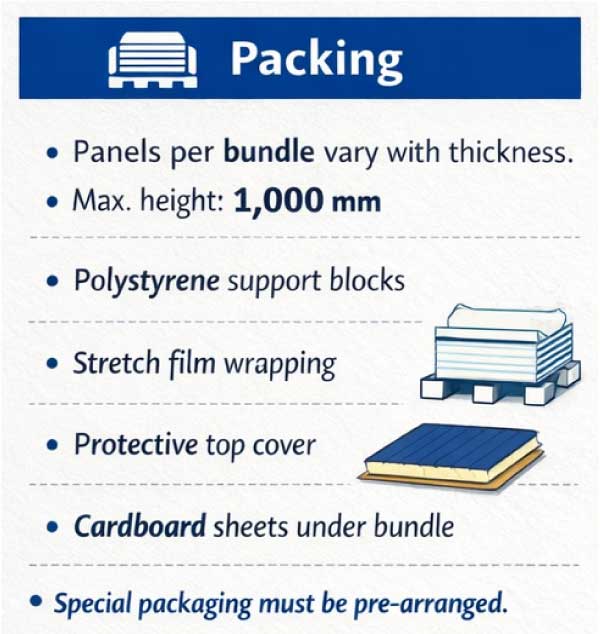
"Any special or customized requirement must be agreed upon before production."
Unless otherwise agreed in writing, sandwich panels are delivered by truck to the site or designated unloading point. The customer is responsible for unloading the materials in accordance with our unloading guidelines.
Upon delivery, all materials must be immediately inspected for integrity and transport damage. Any defects or damage must be reported immediately upon receipt.
Unloading must be carried out carefully, strictly in accordance with our instructions to avoid damaging the panels.
Wooden boards must have a width of 200–250 mm to distribute the load across the width of the panels.
The use of steel cables is strictly prohibited.
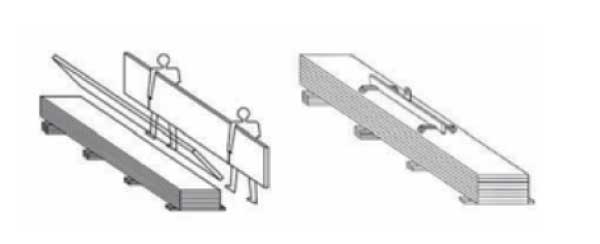
For panels under 7 meters, we recommend unloading them with a forklift.
Technical Diagram A: Crane Unloading
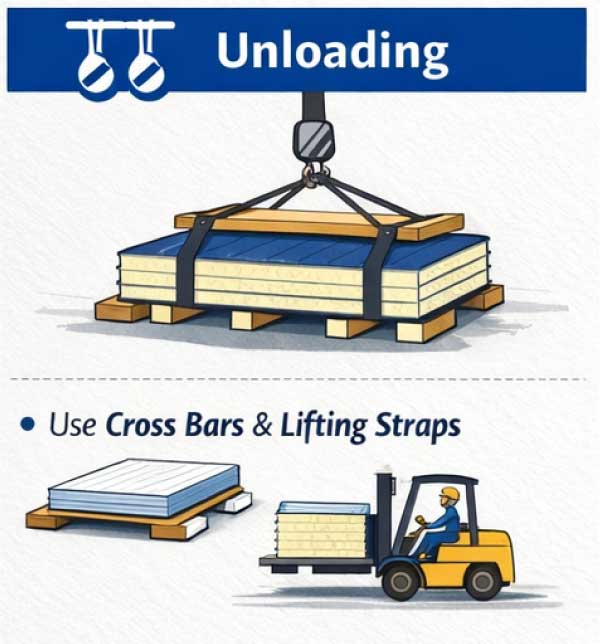
Technical Diagram B: Forklift Method
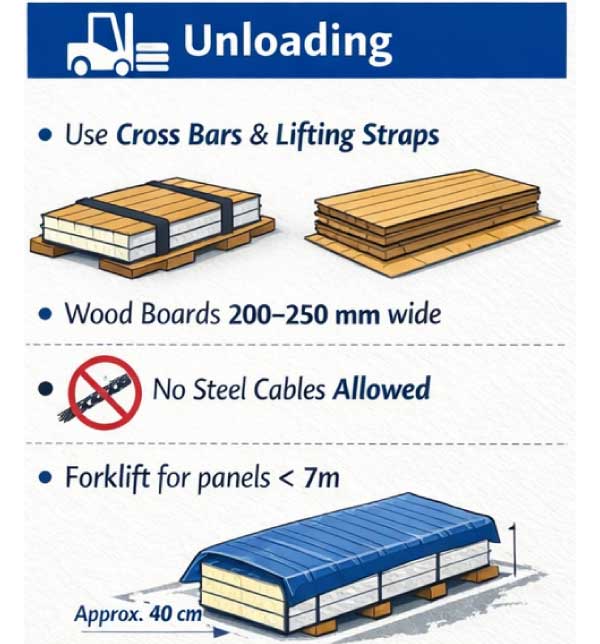
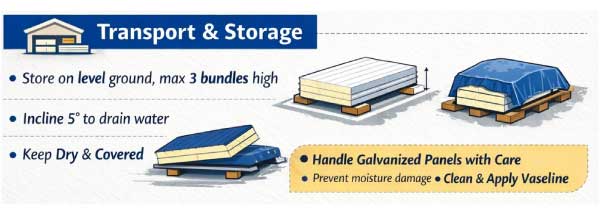
After unloading, bundles must be stored on level ground, with a maximum of three bundles stacked on top of one another.
To prevent water accumulation, bundles should be stored with a slight longitudinal incline of approximately 5%. The maximum unsupported span between supports must not exceed 2 meters. A minimum side clearance of 40 cm must be maintained between adjacent bundles.
Panels must be stored in a dry, covered area. If indoor storage is not available, panels must be protected with tarpaulins or other suitable covers. During dry weather conditions, covers should be temporarily removed to allow ventilation and prevent condensation.
Galvanized panels are particularly sensitive to moisture and should be installed as soon as possible. If white spots or zinc oxide appear, they can be removed using appropriate detergents and water. Panels should then be dried with a cloth, and a light application of Vaseline is recommended on affected surfaces.
We do not assume responsibility for any damage resulting from improper transport or storage conditions.
During installation, all applicable IFBS guidelines for the planning and construction of roofs, walls, and ceilings made of profiled metal panels must be strictly followed. In addition, all relevant roofing standards and industrial construction guidelines must be observed to ensure proper performance, safety, and long-term durability of the system.
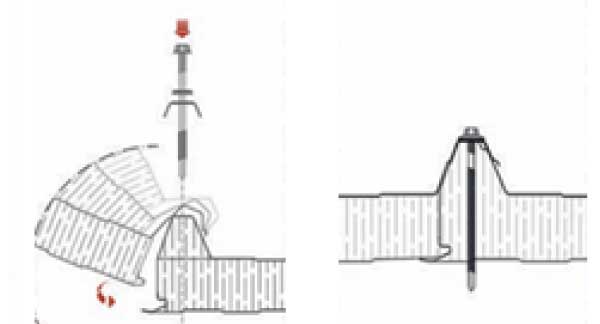
Load distribution plates and screws without sealing washers must be used strictly in accordance with the applicable building authority approvals.
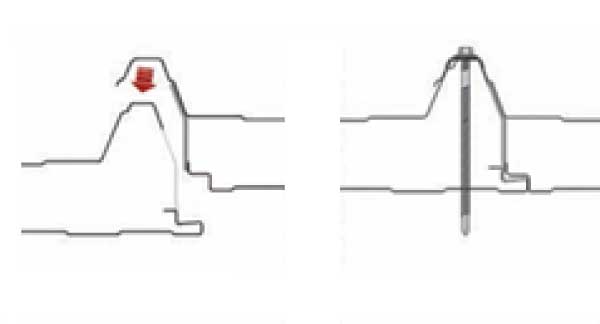
The joint design of cold storage panels allows the panels to be sealed and bonded within the joint, as well as along the visible external groove. This joint system ensures an airtight, vapor-tight, and thermally efficient connection between panels.
Panels are supplied with a protective film on both the interior and exterior surfaces. This film must be removed during installation, or no later than four (4) weeks after delivery, to prevent adhesive residue—particularly after prolonged exposure to direct sunlight.
Max. 4 Weeks
Panel adjustments may be carried out on site as required. All cutting and fitting operations must be performed using appropriate tools, such as a jigsaw or hand-held circular saw.
Saw blades must be fitted with fine teeth to ensure a cold cut, preventing damage to the panel coatings and maintaining proper edge quality.
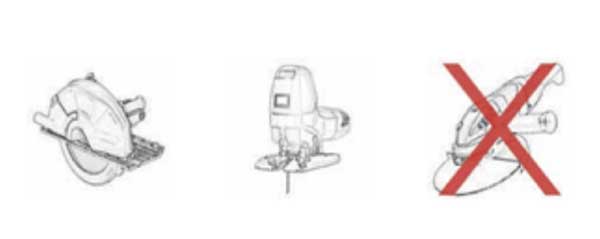
These tools damage the zinc layer and compromise corrosion protection. In addition, angle grinders generate hot particles that can burn into the panel surface. Damage resulting from improper cutting methods will not be accepted as a warranty or damage claim.
As a general rule, panels should be installed against the prevailing weather direction to minimize the impact of wind and weather on panel joints.
| Type | Panel Thickness | Support Spacing (Max) | Fastener Spacing |
|---|---|---|---|
| Wall Panel | 40-60 mm | 1,500 mm (5'-0") | 400 mm (16") |
| Wall Panel | 80-100 mm | 2,000 mm (6'-6") | 450 mm (18") |
| Wall Panel | 120-160 mm | 2,500 mm (8'-0") | 500 mm (20") |
| Wall Panel | 180-200 mm | 3,000 mm (10'-0") | 550 mm (22") |
| Roof Panel | 40-60 mm | 1,500 mm (5'-0") | 300 mm (12") |
| Roof Panel | 80-100 mm | 2,000 mm (6'-6") | 350 mm (14") |
| Roof Panel | 120-160 mm | 2,500 mm (8'-0") | 400 mm (16") |
| Roof Panel | 180-200 mm | 3,000 mm (10'-0") | 450 mm (18") |
Installers should be aware that handling and installation are more demanding due to the increased panel weight.
Prior to installation, all required sealing tapes must be applied to the substructure to ensure proper airtightness and weather sealing.
Stainless steel fasteners must be used in accordance with general building approval No. Z-14.4-407 or ETA. Only Ü-marked or CE-marked screws are permitted.
Our engineering team is ready to assist you with the logistics and assembly of your panels.